Independent research confirms ACUE professional development and certification delivers significantly stronger results for students.
A new independent study published in the Journal on Excellence in College Teaching found that students taught by ACUE-certified faculty show improved learning outcomes. Specifically, the data show that these students are significantly more likely to pass their courses, rate their instructors more highly, and avoid the poor grades and withdrawals that derail degree completion. Conducted by researchers at Sam Houston State University (SHSU), with no funding or influence from ACUE, the study examined nearly 1,800 courses, making it the largest and most rigorous independent examination of ACUE’s impact to date.
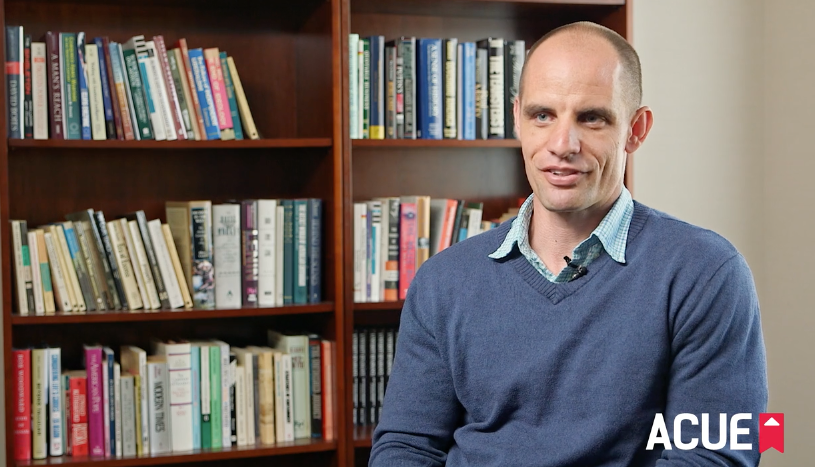
Download the study“We now have airtight evidence that faculty participating in ACUE professional development directly contribute to their institution’s goals,” said author Benjamin Mitchell-Yellin, PhD, Director of the Teaching & Learning Center (TLC) and Associate Professor, Sam Houston State University. “This is a concrete intervention we can implement at an individual instructor level to address retention and persistence—outcomes that are particularly critical at a time when institutions are facing ongoing enrollment challenges.”
What the Study Found
Findings support the impact of the ACUE Certification in Effective Teaching in promoting better educational experiences and outcomes for students. Analyzing data from 1,707 comparable courses taught during the 2021–2022 academic year, researchers found that courses taught by ACUE-certified instructors significantly outperformed those taught by non-certified instructors across every measure studied:
- Higher student evaluations: Certified instructors received significantly higher scores on their end-of-term IDEA evaluations, providing Excellent Teacher and Excellent Course ratings.
- Lower DFW rates: Courses led by certified instructors had a 3.33 percentage point reduction in DFW rates (D or F grades, or course withdrawals).
- Stronger results in introductory courses: The impact was most pronounced in entry-level courses, where certified instructors achieved a 3.73 percentage point reduction in DFW rates.
The study employed propensity score matching and multivariate statistical analysis to control for class size, instructor demographics, and other variables, ensuring the results reflect the impact of ACUE certification itself, not confounding factors.
“In every course redesign meeting, we hear the same thing: students are underprepared, they learned bad habits, this generation is different,” said study co-author Chase Young, PhD, Professor and Associate Director of Assessments, Sam Houston State University. “But the research shows the variable we can control is teaching. Tools like ACUE support faculty to overcome barriers to student success.”
Why This Study Matters
Previous research on ACUE’s effectiveness that also showed better student outcomes had been conducted in partnership with ACUE or relied on smaller sample sizes. This study contributes to an independent validation of ACUE’s impact.
The findings are especially meaningful for introductory courses, where DFW rates are typically highest and where the stakes for student persistence and degree completion are greatest. SHSU’s student body reflects a diverse population of students: 48% White, 26% Hispanic or Latino, 16% Black or African American, with a large proportion of first-generation college students.
Ted Mitchell, President of the American Council on Education added: “This is what accountability in higher education looks like. Independent researchers. Rigorous methodology. Nearly 1,800 courses. And results that confirm what we at ACE have believed for nearly a decade—that investing in faculty development through ACUE produces measurably better outcomes for students. Institutions that are serious about student success now have the evidence they need.”
About the Study
“The Impact of the Association of College and University Educators (ACUE) Certification on Instructor Evaluations and Student Success Rates,” was authored by Dr. Benjamin Mitchell-Yellin, Director of the Teaching & Learning Center and Associate Professor of Philosophy at SHSU, and Dr. Chase Young, Professor of Literacy Education and Associate Director of Assessment at SHSU. The research was partially supported by the National Science Foundation (Grant No. NSF 2247928) and received full IRB approval.
About SHSU’s Teaching & Learning Center (TLC)
The Teaching & Learning Center (TLC) creates and disseminates innovative educational initiatives for instructors across all levels at Sam Houston State University. They support interdisciplinary collaborations to further the scholarship of teaching and learning. Collectively these efforts work to elevate the university’s legacy of teaching excellence while energizing instructors to invigorate student success.
About ACUE
The Association of College and University Educators (ACUE) is dedicated to student success through high-quality instruction. In partnership with higher education institutions, they offer the only nationally recognized Effective Teaching certification, endorsed by the American Council on Education (ACE), supported by a vibrant community of practice focused on advancing teaching excellence. ACUE-certified faculty deliver exceptional teaching in every class, resulting in higher student engagement, improved achievement, and stronger retention—outcomes that enhance institutional impact and support long-term student success. Learn more at acue.org.