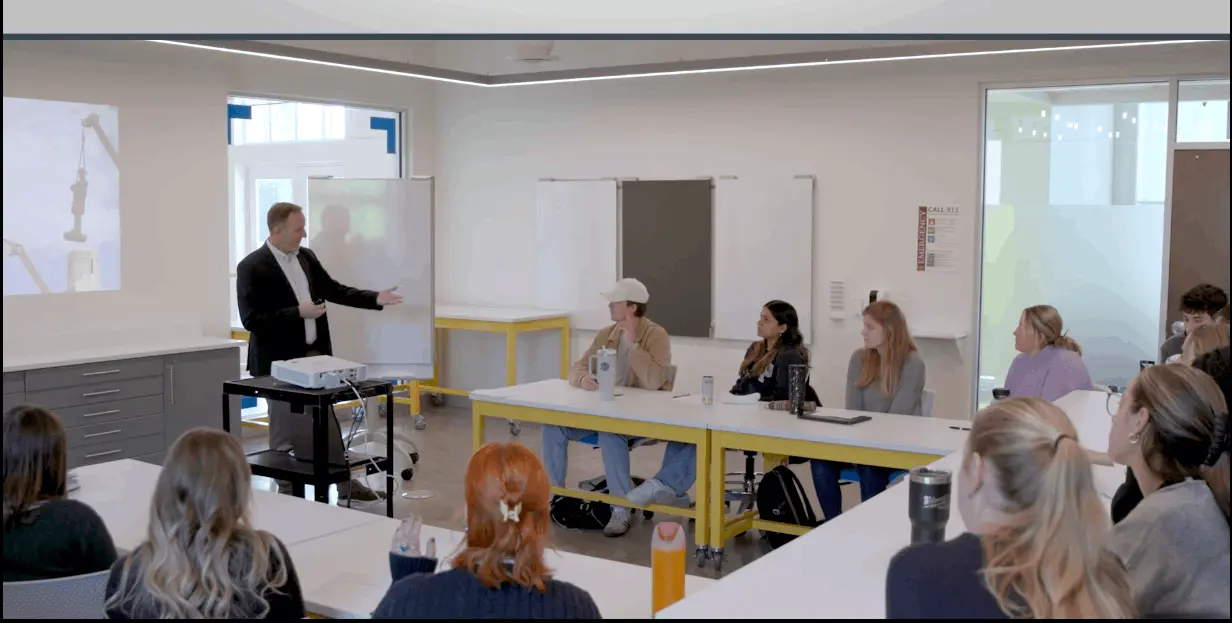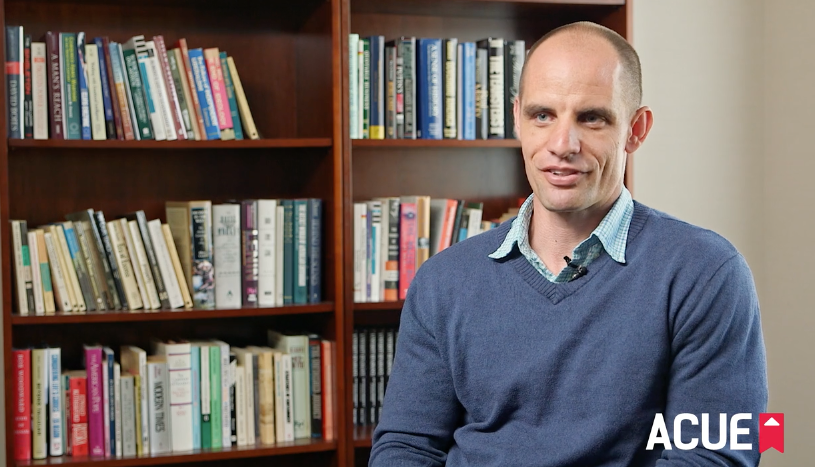
Dr. Michael Wesch, a subject matter expert in ACUE’s Course in Effective Teaching Practices, is in the spotlight for ACUE’s first Expert Series of 2017.
Dr. Wesch, associate professor of cultural anthropology at Kansas State University, offers illuminating insights about what prompted him to change his approach to teaching, the pitfalls of a fixed mindset, and how to drive student outcomes by helping students identify with the person they aspire to become. Accompanying Dr. Wesch this month are video interviews with his students explaining how his teaching techniques keep them more engaged in class and motivated to learn.
How do you define deep learning?
I think you have to contrast deep learning with “superficial” or “strategic” learning. Strategic learning is where you’re trying to learn for the test, whereas deep learning is really about a transformation of the self. Strategic learning tends to be temporary and largely driven toward extrinsic rewards that are also temporary, and ultimately is unlikely to be transformed into knowledge that can be used in other domains. For deep learning, you set out with a very different intention: changing yourself and absorbing the material for long-term growth.
What inspired you to rethink your approach to teaching?
As a student, I was strategic to absurdity. I simply wanted to get an A and I would do the minimum amount of work for it. Nothing I was reading inspired me enough to take it home. I was able to strategically get the things I needed out of a book by skimming and pulling out the main points.
And then one day I just fell in love with reading and the stuff I was learning. When I first started teaching, I forgot that my students were doing the same thing I used to do—just skimming the material and finding the information. I made a lot of assumptions when I first started teaching: Of course people are going to love this stuff the way I love this stuff. Why wouldn’t they love this material?
And I assumed that it was “the stuff” that mattered. So I assigned readings that I thought were really exciting.
It really became apparent that my students were not engaged in deep learning when I noticed that they were asking questions like “What’s gonna be on the test?” That’s a clear indication of strategic learning. That was the trigger that there was just this total disconnect between me and my students. So that led to the whole flip and a lot of changes in how I teach.
What are some fixed mindset traps that faculty should avoid?
It’s very easy to fall into a fixed mindset trap, especially as a professor, because a fixed mindset is where you’re keeping score about how smart you are. Professors tend to be very smart. In most situations you’re the smartest person in the room within your domain, so I think the first fixed mindset trap is feeling like you know everything, and that whatever’s going wrong with the classroom has to do with the students and not you. It’s much more useful to assess what you’re doing and how you can change what you’re doing to change the classroom.
The second trap is just sort of a depressed feeling of not being good enough. I think that strikes professors all the time because we’re often facing classes where people are glazed over and tuning out and on their smartphones. Some of us, like myself, take that very hard. You fall into this trap where you take all that information that clearly things aren’t going well and you internalize it as your own fault. You then relate that to a fixed trait of yourself. You say to yourself “Well I’m just not that charismatic and I just can’t tell a good story” or “I just can’t do x, y, or z.” It’s similar to when a student says “I’m just not a math person.” So I think we have to recognize that we all have these weaknesses, that doesn’t mean that we’re stuck with them forever. Just do a little bit to get a little better every day.
What advice do you have for veteran instructors to encourage them to continue learning and creating?
The simple thing is to always be trying something new; novelty is really important to learning and to motivation. As an anthropologist, I believe novelty is essential to the human story and it’s a very powerful stimulus. Everybody’s probably experienced the feeling when you walk into class on the first day with last year’s lecture notes and nothing else. It doesn’t matter if it was amazing last year. It’s not going to be amazing this year—even if you follow the same notes—because you won’t feel it and they won’t feel it.
At a minimum, you have to change a few things every day. I’ve implemented a 28-day challenge in almost all of my classes. It’s fun and it creates a sense of cohesion. As an experiment, the students have to do something new for 28 days. Among 440 students, a good bunch of them chose a musical instrument. I chose the violin and about seven of us started getting together every week to practice as the 28-Day Band. We premiered in front of the class. Going through a process like that is a wonderful reminder of the difficulty and the awesomeness of learning itself.
Tell us about some teaching and learning ideas or aspects that have recently excited you.
I feel like we’ve mapped out fairly well how teaching and learning work if you take all the literature on teaching and learning as a whole. You have to deal with motivation factors, like balancing the extrinsic with the intrinsic. You have to think about how the brain learns and make sure that your material is in line with how the brain learns.
One other thing I have been considering is the importance of identity and how students really learn incredibly fast and incredibly deeply when they start to identify with the person they’re going to become after they’ve learned it—not with the stuff they’re learning. Let’s say, in simple terms, that the students in my class start to identify as anthropologists. They will learn all the techniques of anthropology in a much deeper way than if they were identifying as “somebody who’s just coasting through college.” So that shift in identity is really essential. I think it could go a long way to help students identify, minimally, as someone who’s trying to grow themselves and be the best self they can be—not someone who’s just trying to get a grade. And that goes a long way in shifting them toward deep learning.
Dr. Wesch currently serves as an Associate Professor of Cultural Anthropology at Kansas State University. He is featured in the following modules in ACUE’s Course in Effective Teaching Practices:
- Preparing an Effective Syllabus
- Embracing Diversity in Your Classroom
- Developing Fair, Consistent, and Transparent Grading Practices